
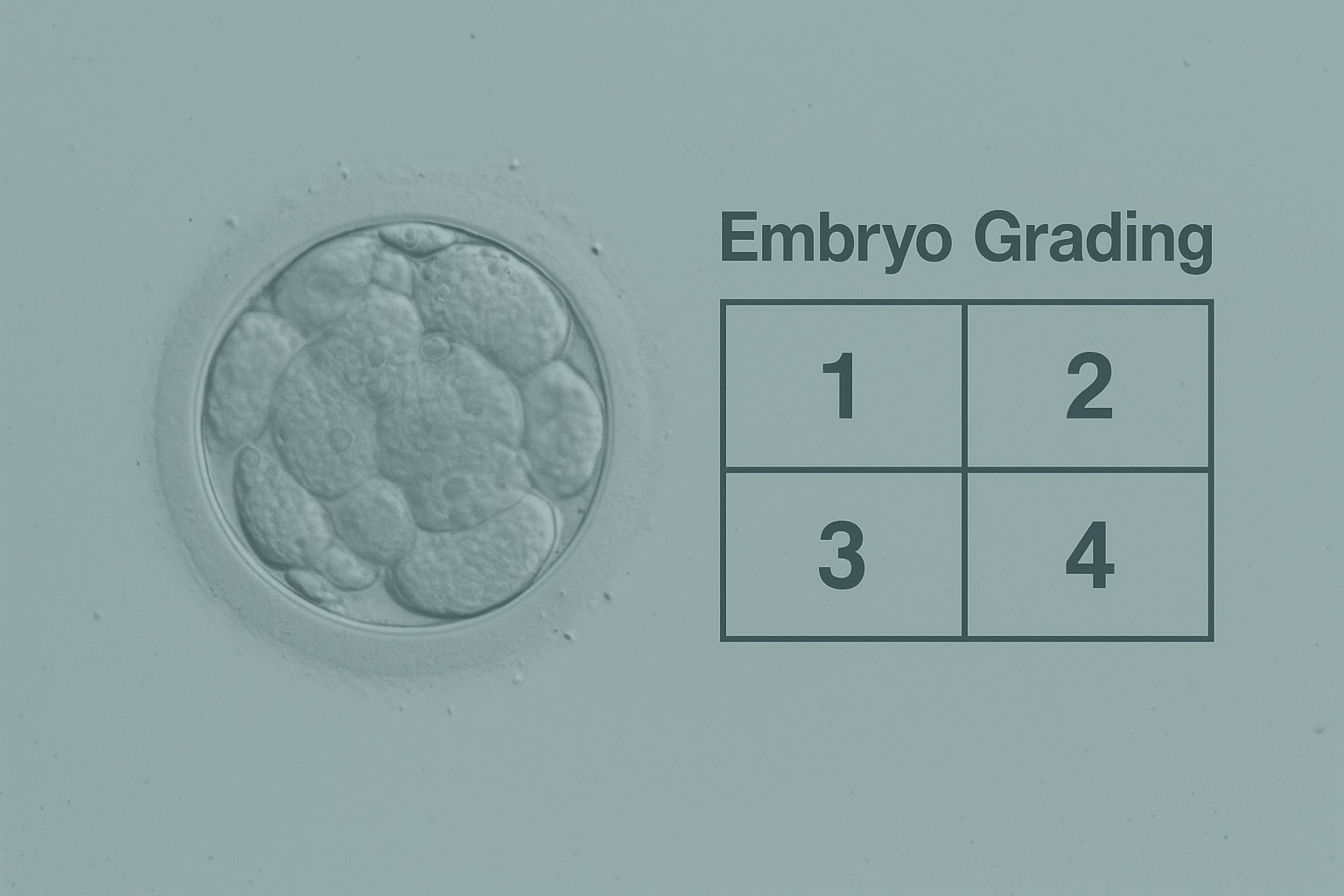
When you begin IVF or surrogacy, one of the first technical terms you’ll encounter is “embryo grading.”
Clinics use this system to assess embryo quality before transfer or freezing — but to many intended parents, the numbers and letters sound mysterious.
At Global Surrogacy Advisors, we help demystify the science so you can make informed decisions with confidence.
The Basics: From Egg to Embryo to Blastocyst
After fertilisation, embryos are cultured in the lab for up to five or six days. During this time, embryologists examine them daily to track growth and structure.
By day 5–6, embryos that reach a certain stage are called blastocysts — and these are what most clinics grade and transfer.
The aim is to predict which embryos are most likely to implant successfully in the uterus.
The Grading System in Simple Terms
The most common method is the Gardner and Schoolcraft system, which gives each blastocyst a number (1–6) and two letters (A–C):
- Number = Expansion stage
- 1 = Early blastocyst (still compact)
- 3 = Expanded
- 5 = Hatching
- 6 = Fully hatched
- First letter = Inner cell mass (ICM) — the part that becomes the baby
- A = many tightly packed cells (high quality)
- B = looser cells (good quality)
- C = few cells (lower quality)
- Second letter = Trophectoderm — forms the placenta
- A = many uniform cells
- B = fewer cells with gaps
- C = thin or uneven layer
So an embryo graded 5AA is a hatching blastocyst with both strong ICM and trophectoderm — essentially “excellent quality.”
A 3BC might still be usable, but has lower predicted potential.
(Reference: American Society for Reproductive Medicine)
Does a Higher Grade Mean a Better Baby?
Not necessarily. Grading reflects appearance, not genetic normality.
Some embryos that look “average” still produce healthy pregnancies, while high-grade ones sometimes don’t implant.
That’s why many clinics combine grading with PGT-A (Pre-implantation Genetic Testing for Aneuploidy) to check chromosome balance.
PGT-A doesn’t guarantee success, but it improves the odds when choosing among several embryos.
(Reference: NIH — PGT-A Study Summary)
Fresh vs Frozen Embryos
Modern vitrification techniques mean frozen embryos maintain nearly the same success rates as fresh ones.
Grading is performed before freezing, and quality tends to remain stable after thawing.
At Global Surrogacy Advisors, we help clients interpret their clinic reports and understand which embryos are most suitable for transfer or future use.
What Intended Parents Should Ask Their Clinic
- How does your clinic grade embryos — and what criteria do you use?
- How do grades relate to success rates for my age group or donor type?
- Is PGT-A recommended for my situation?
- How many embryos will you transfer per cycle and why?
Understanding these details ensures you’re making data-driven decisions rather than emotional ones.
Empowered Through Knowledge
Numbers and letters can’t capture hope or heart — but they can help guide you toward the strongest possibility of success.
With the right team and independent advice, you can trust the science and stay focused on the journey ahead.
👉 Book your free consultation with Global Surrogacy Advisors